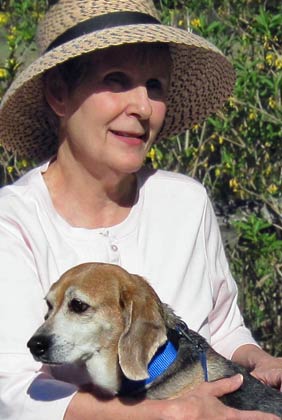
Meet Leslie Frontz, AWS

Leslie Frontz

A Review of Leslie's Work

Leslie Frontz studied watercolor with Bernard Evans in Britain, the birthplace of watercolor painting as a fine art medium. To this day, the artist's admiration for the traditional English school of watercolor is clearly evident in her work. Her painting technique is clean and direct, using a minimum amount of brushwork to indicate her subjects with great simplicity. The effect leaves much to our imagination while convincing us of the authenticity of her observations. Balancing luminous grays against pure color accents, she captures not only the literal scene, but also instills it with light and atmosphere.

One notices immediately that landscapes dominate her catalog. A closer inspection, however, reveals her preference for subjects that incorporate a human element--figures, architecture and maritime themes. It should not be surprising that subjects from both Britain and America hold a prominent place in her work, as she maintains family ties on both sides of the Atlantic. To even the most informed eye, her appeal covers an astonishingly broad range.

Classicists will appreciate an obvious bow to European traditions in her work. Although these paintings are modern in subject, in style they have the brevity of Impressionism. Her experiments with pattern and composition as independent elements are akin to more modern viewpoints.

This artist's fresh approach, uniting elements from multiple creative philosophies, makes her paintings unequaled.

Written by James Robinson
Hudson Writers Guild, © 2004

Biography

Leslie Frontz is a multi-faceted artist, but it is likely that she will be best remembered for her watercolors. Although she received her first professional paintbox at the age of thirteen, it was her later introduction to watercolors that prompted her to become a professional artist. Leslie earned the M.F.A. degree in studio arts from the University of North Carolina at Greensboro, formerly the Women's College of North Carolina, where she was the first graduating recipient of the Holderness Fellowship. The artist has been recognized in "Who's Who in America" and "Who's Who in American Art," featured in "The Artist's Magazine" and "U.S. Art," and has exhibited work at numerous museums and galleries, including the Smithsonian and the Mall Galleries in London. She is an elected member of the prestigious Society of Women Artists in London, a member of the Southern Watercolor Society in the U.S., and a founding member of Plein Air Carolina. Leslie has 25 years experience as a professional artist and teacher. She currently is a faculty member at Davidson County Community College in Lexington, North Carolina.


Artist's Statement

I express myself in watercolors painted in the British style. In the hand of British masters, watercolor evolved into an extraordinarily rich, expressive medium that acquired a decidedly indigenous stamp. "Watercolour as an art form has long been the way in which the British have best expressed themselves," contends Richard Hagen, Director of Hagen Gallery in Broadway, England. "Their work has left an indelible impression on all those who have followed. It is in the wake of this tradition that the artists of today aspire."

Like my predecessors, I prefer working in a representational style, drawing inspiration from many sources in my daily environment. Also, my work is constructed with a strong awareness of design elements. The underlying shapes and colors carry the subject and communicate its mood.

Likewise, my choice of format and use of materials is influenced by British watercolorists. Often relatively small in scale, I like to think of these works as "little gems." Great things can come in small packages.

I also avail myself of a more continental palette, incorporating sedimentary as well as earth pigments: the granular blues, rich browns and muted golds. British artists do not avoid the subtle color mixtures that many watercolorists fear will produce "mud." The secret to producing transparent watercolors is in knowing your materials and how to use them, not in the pigments themselves.

For paper, I prefer Saunders' Waterford brand, manufactured at an English mill in operation since the 1700s. I was introduced to this product while studying in Cornwall and was immediately drawn to its responsive and versatile surface.

As brushwork is a key component of British watercolors, so is the choice of brushes. The British artist's distinctive "handwriting" is acclaimed as deft, vigorous and spontaneous. For this reason, I rely more heavily on round, sable brushes. They are more expensive but have a shape and suppleness that allows for an incomparable array of effects.

It seems inevitable that I would eventually be drawn toward the watercolor regimen of British artists. My roots there run deep: my family and relatives have lived on the same farmland in the United Kingdom for 250 years.

Leslie Frontz, AWS, SWA

Read an Interview with Leslie and Harold